

Showing posts with label food reading. Show all posts
Showing posts with label food reading. Show all posts
Sunday, August 30, 2015
Relish by Lucy Knisley [book review]
I just finished reading Relish: My Life in the Kitchen by Lucy Knisley. It's the first graphic book I have read and it was so fun! It was a Kitchen Reader book--it's a memoir by a girl who was raised by a mother who was a catering chef and a father who was a gourmand. I found that it started off a bit self-aggrandizing (there's some name dropping of her mother's friends/clients), but after a couple of chapters I was charmed by Knisley's childhood.


Friday, July 31, 2015
Delicious! by Ruth Reichl [book review]
In July each year our Kitchen Reader book club reads a food-related novel. This time it was Delicious! by Ruth Reichl. We have read two of Reichl's non-fiction books before: Tender at the Bone and Garlic and Sapphires (these links are to my reviews of them). They were both excellent so I felt that a novel by Reichl probably wouldn't disappoint us.

Billie is a young woman who is hired on as the assistant to the editor of a food magazine called Delicious!. The novel tells some hilarious stories about the people and food she encounters. As with Reichl's other books, the food descriptions are top notch and made me salivate quite regularly. In the novel, James Beard was a flashback character, and Billie discovers about his time at the magazine though a series of letters written to him by a young reader.
by Ruth Reichl. We have read two of Reichl's non-fiction books before: Tender at the Bone and Garlic and Sapphires (these links are to my reviews of them). They were both excellent so I felt that a novel by Reichl probably wouldn't disappoint us.
Billie is a young woman who is hired on as the assistant to the editor of a food magazine called Delicious!. The novel tells some hilarious stories about the people and food she encounters. As with Reichl's other books, the food descriptions are top notch and made me salivate quite regularly. In the novel, James Beard was a flashback character, and Billie discovers about his time at the magazine though a series of letters written to him by a young reader.
Sunday, May 31, 2015
Food: A Love Story by Jim Gaffigan [book review]
Our May book for the Kitchen Reader was Food: A Love Story by Jim Gaffigan. It's hilarious. Here's a sampling of the delights.
Cheese and Gratitude
"There's an old Weight Watchers saying, 'Nothing tastes as good as thin feels.' I for one can think of a thousand things that taste better than thin feels. Many of them are two-word phrases that end with cheese (Cheddar cheese, blue cheese, grilled cheese)."

"In America we have gone way beyond sustenance. Eating is an activity. 'Why don't we get lunch, and then we'll grab some pizza.' Most Americans eat constantly. And when we're not eating, we're chewing gum. We are literally practicing eating. We chew gum with a swagger and purpose that says, 'Yeah, I got a big meal coming up. I'm training for Thanksgiving.'"
"My wife likes to pause before the meals with our [five] kids and say grace. While I think this is a great opportunity for our children to learn to appreciate the gifts God has given them, I view grace as kind of 'On your mark, get set...' and the 'Amen' and the 'Go!'. I am pretty sure that's the way God intended it."

Cheese and Gratitude
"There's an old Weight Watchers saying, 'Nothing tastes as good as thin feels.' I for one can think of a thousand things that taste better than thin feels. Many of them are two-word phrases that end with cheese (Cheddar cheese, blue cheese, grilled cheese)."

"In America we have gone way beyond sustenance. Eating is an activity. 'Why don't we get lunch, and then we'll grab some pizza.' Most Americans eat constantly. And when we're not eating, we're chewing gum. We are literally practicing eating. We chew gum with a swagger and purpose that says, 'Yeah, I got a big meal coming up. I'm training for Thanksgiving.'"
"My wife likes to pause before the meals with our [five] kids and say grace. While I think this is a great opportunity for our children to learn to appreciate the gifts God has given them, I view grace as kind of 'On your mark, get set...' and the 'Amen' and the 'Go!'. I am pretty sure that's the way God intended it."

Friday, May 1, 2015
Ratio by MIchael Ruhlman [book review]
Our April Kitchen Reader book is Ratio: The Simple Codes Behind the Craft of Everyday Cooking by Michael Ruhlman. In it, he explains how many classic dishes can be described using a simple ratio. For example, bread doughs for loaves, pasta, pies, biscuits, and cookies have similar ratios of flour, water, and eggs or fat. How much of each in the ratio determines what kind of item you are making.

Besides doughs, Rulhman describes the ratios for batters (which make different cakes, muffins, and fritters), stocks, roux, meat mixtures (sausages, for example), fat-based sauces (such as mayonnaise and hollandaise), and custards. I am a grain-free cook, so I skipped over all the baked goods, but for those who make breads and cakes, I imagine this is the most useful part of the book. It's also extensive and detailed. This is a little ironic, since Ruhlman is trying to champion the idea that once you know the basic ratios you are freed from recipes and complications.
by Michael Ruhlman. In it, he explains how many classic dishes can be described using a simple ratio. For example, bread doughs for loaves, pasta, pies, biscuits, and cookies have similar ratios of flour, water, and eggs or fat. How much of each in the ratio determines what kind of item you are making.
Besides doughs, Rulhman describes the ratios for batters (which make different cakes, muffins, and fritters), stocks, roux, meat mixtures (sausages, for example), fat-based sauces (such as mayonnaise and hollandaise), and custards. I am a grain-free cook, so I skipped over all the baked goods, but for those who make breads and cakes, I imagine this is the most useful part of the book. It's also extensive and detailed. This is a little ironic, since Ruhlman is trying to champion the idea that once you know the basic ratios you are freed from recipes and complications.
Saturday, April 18, 2015
An Omelette and a Glass of Wine by Elizabeth David [book review]
Elizabeth David was an English food writer after the Second World War who revolutionized food writing in the UK. She was highly opinionated and very judgemental of the British food of her time. She spent a lot of time in Europe and praised the ingredients and preparation of regular restaurants there as being far superior to that of the UK. She lauded the "peasant" food of the Mediterranean, and paid vast sums to have fresh produce imported from Europe; this wasn't a luxury available to ordinary British families. David was not interested in reaching ordinary families, though; she was focused on middle-class and upper middle-class audiences and was content being considered a snob.
For the Kitchen Reader book club in March, we were tasked with reading any work by or about Elizabeth David and I chose a collection of her published essays called An Omelette and a Glass of Wine . I was prepared to be entertained and to learn a lot about good, fresh food.

For the Kitchen Reader book club in March, we were tasked with reading any work by or about Elizabeth David and I chose a collection of her published essays called An Omelette and a Glass of Wine
. I was prepared to be entertained and to learn a lot about good, fresh food.
Monday, March 2, 2015
Extra Virginity by Tom Mueller [book review]
This month's Kitchen Reader book was Extra Virginity: The Sublime and Scandalous World of Olive Oil by Tom Mueller (chosen by Amanda of Omar Niode Foundation).
This is a wide-ranging book, both in place and time. Olive oil has been in use since ancient times as a food; over time it has also been used as a fuel for lighting, a perfume, cosmetic, for religious annointing, as a fabric softener, contraceptive, detergent, preservative, pesticide, medicine, and machine lubricant.

Featured in the book is an olive oil producing family who run Castillo de Canena in Spain. (I have discovered an importer of theirs in Singapore: Delicia, so I plan to try their oils soon.) The brother and sister team come from a family that has been making oil since 1780 and they currently have 280000 trees. They make a low-grade bulk oil, which accounts for 95% of their production, and a line of high-quality extra virgin oil that already (as of 2013) accounts for a quarter of their profits. Their joy is in bringing out the best flavours in their premium oils by experimenting with irrigation, harvesting, and making small batches.
This is a wide-ranging book, both in place and time. Olive oil has been in use since ancient times as a food; over time it has also been used as a fuel for lighting, a perfume, cosmetic, for religious annointing, as a fabric softener, contraceptive, detergent, preservative, pesticide, medicine, and machine lubricant.

Featured in the book is an olive oil producing family who run Castillo de Canena in Spain. (I have discovered an importer of theirs in Singapore: Delicia, so I plan to try their oils soon.) The brother and sister team come from a family that has been making oil since 1780 and they currently have 280000 trees. They make a low-grade bulk oil, which accounts for 95% of their production, and a line of high-quality extra virgin oil that already (as of 2013) accounts for a quarter of their profits. Their joy is in bringing out the best flavours in their premium oils by experimenting with irrigation, harvesting, and making small batches.
Sunday, February 1, 2015
Food Gurus by Stephen Vines [book review]--and Sesame and Dukkah Cubes
Food Gurus: 20 People Who Changed the Way We Eat and Think About Food by Stephen Vines is a collection of essays about people who have impacted food today. The figures examined range from Bartolomeo Platina (1421-1481) to current food personalities including Gordon Ramsay, Jamie Oliver, and Alice Waters.
The book covers a diverse collection of cooks, chefs, and writers. Platina was (arguably) the person who first created cookbooks and popularized the idea of cooking from a recipe. There are a handful of French greats included, such as Georges August Escoffier, Fernand Point, and Antonin Careme. More recent figures are Delia Smith, Elizabeth David, Julia Child, Dr Atkins, and Ray Kroc, the founder of McDonald's.

by Stephen Vines is a collection of essays about people who have impacted food today. The figures examined range from Bartolomeo Platina (1421-1481) to current food personalities including Gordon Ramsay, Jamie Oliver, and Alice Waters.The book covers a diverse collection of cooks, chefs, and writers. Platina was (arguably) the person who first created cookbooks and popularized the idea of cooking from a recipe. There are a handful of French greats included, such as Georges August Escoffier, Fernand Point, and Antonin Careme. More recent figures are Delia Smith, Elizabeth David, Julia Child, Dr Atkins, and Ray Kroc, the founder of McDonald's.
Friday, January 30, 2015
Foodies Read Challenge 2015
I'm joining a blogging challenge called Foodies Read. This will become the landing page for all my food-related reading during 2015. I plan to read nine to thirteen books, making me a "sous-chef" level member. This will be easy(ish) to achieve thanks to my ongoing membership of the food-related book club, the Kitchen Reader. Would you like to join in?
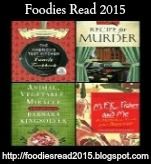
My 2015 food books:
My 2015 food books:
Saturday, January 10, 2015
Weekend Links #39
Weekend Links is a way of sharing all the engrossing things I see around the internet. I publish Weekend Links approximately every month. As usual, I welcome your ideas and feedback.
food reading links:
--This pictorial guide to mushrooms (from Oh My Veggies) takes you through the main types, storage, and preparation.
--A guide to recipe copyright by Paleo Living Magazine. An in-depth look at recipe copyright from all angles.
--I'm still trying to find healthy milk to drink - and the latest wandering step is A2 Milk.
recipe links:
--I find wine too hard to navigate so I think I will try to learn something about whiskey instead. Here is a list of the best affordable bottles (from Serious Eats). And here's an extremely simple cocktail made with whiskey called The Presbyterian (from Martha Stewart). There's also the hot toddy, of course (from The Guardian's wonderful How to Make the Perfect [weekly recipe] column by Felicity Cloake).
--German mulled wine (from Rachel Cotterill). Even though I live in the tropics I am still desiring this warming Christmassy winter drink.
--I'm going to be making some veggie "risotto" soon and I plan to use this recipe as a guide: turnip "risotto" with spinach and rosemary (from Inspiralized).
books I'm reading:
--I just finished Man's Search for Meaning by Victor E Frankl, a classic which argues that we can all make choices and our life's meaning is found in making them.
--The Signal and the Noise: The Art and Science of Prediction by Nate Silver. It's about separating out the "signal" in data to help make predictions. He covers many fields such as weather, earthquakes, elections, sports, and health. Fascinating.
food reading links:
--This pictorial guide to mushrooms (from Oh My Veggies) takes you through the main types, storage, and preparation.
--A guide to recipe copyright by Paleo Living Magazine. An in-depth look at recipe copyright from all angles.
--I'm still trying to find healthy milk to drink - and the latest wandering step is A2 Milk.
recipe links:
--I find wine too hard to navigate so I think I will try to learn something about whiskey instead. Here is a list of the best affordable bottles (from Serious Eats). And here's an extremely simple cocktail made with whiskey called The Presbyterian (from Martha Stewart). There's also the hot toddy, of course (from The Guardian's wonderful How to Make the Perfect [weekly recipe] column by Felicity Cloake).
--German mulled wine (from Rachel Cotterill). Even though I live in the tropics I am still desiring this warming Christmassy winter drink.
--I'm going to be making some veggie "risotto" soon and I plan to use this recipe as a guide: turnip "risotto" with spinach and rosemary (from Inspiralized).
books I'm reading:
--I just finished Man's Search for Meaning by Victor E Frankl, a classic which argues that we can all make choices and our life's meaning is found in making them.
--The Signal and the Noise: The Art and Science of Prediction
by Nate Silver. It's about separating out the "signal" in data to help make predictions. He covers many fields such as weather, earthquakes, elections, sports, and health. Fascinating.
Sunday, November 30, 2014
Born Round by Frank Bruni [book review] & Italian Creamed Onions

I just finished reading Born Round: A Story of Family, Food and a Ferocious Appetite
 by Frank Bruni, a memoir by the former New York Times restaurant critic. It was very engaging to read about his American-Italian childhood. I was enraptured by the stories of the feasts his grandmother, aunts, and mother created for family events. Having a huge bounty of food was a sign of love in his family. Special occasions always merited a massive spread of food for the whole extended family. His grandmother even had two kitchens in her house, one in the basement for creating the plethora of dishes, and one upstairs for guests to marvel at how she cooked it all without leaving the kitchen in a disastrous mess. One of the dishes I made after reading about it was creamed onions.
Saturday, November 22, 2014
Weekend Links #38
Weekend Links is a way of sharing all the engrossing things I see around the internet. I publish Weekend Links approximately every month. As usual, I welcome your ideas and feedback.
food reading links:
--This guest post on Eating Rules identifies one way in which thinking mathematically about our food can help (or hinder) us making healthy decisions: Math and Food: A Thought Experiment.
--How to help the world by not eating local, from Casual Kitchen. I follow Daniel for consistently quality posts like this one. (Related: This post about how food miles don't make up the most important part of environmental impact of food, from Farming Futures.)

recipe links:
--Flaxseed focaccia bread (from Healthful Pursuit); not only is it grain-free but it's got very few ingredients and they are all "ordinary" ones.
--Some vegetarian burgers that are made with cauliflower and chickpeas, hence they are called cauliflower hummus burgers. How great does that sound? From Oh My Veggies.
--Some people still don't know that cauliflower can be amazingly tasty. For this person, there is cocoa roasted cauliflower, from The Taste Space.
--I have made this pumpkin spice latte (from The Nourishing Gourmet) at home a few times for my autumn fix, since Starbucks here in Singapore doesn't sell it. In fact, in October they were already serving their Christmas drinks. Pfffft.
--Chocolate pecan pie, from Elana's Pantry. Holiday food!
food reading links:
--This guest post on Eating Rules identifies one way in which thinking mathematically about our food can help (or hinder) us making healthy decisions: Math and Food: A Thought Experiment.
--How to help the world by not eating local, from Casual Kitchen. I follow Daniel for consistently quality posts like this one. (Related: This post about how food miles don't make up the most important part of environmental impact of food, from Farming Futures.)

recipe links:
--Flaxseed focaccia bread (from Healthful Pursuit); not only is it grain-free but it's got very few ingredients and they are all "ordinary" ones.
--Some vegetarian burgers that are made with cauliflower and chickpeas, hence they are called cauliflower hummus burgers. How great does that sound? From Oh My Veggies.
--Some people still don't know that cauliflower can be amazingly tasty. For this person, there is cocoa roasted cauliflower, from The Taste Space.
--I have made this pumpkin spice latte (from The Nourishing Gourmet) at home a few times for my autumn fix, since Starbucks here in Singapore doesn't sell it. In fact, in October they were already serving their Christmas drinks. Pfffft.
--Chocolate pecan pie, from Elana's Pantry. Holiday food!
Friday, October 31, 2014
Anything that Moves by Dana Goodyear [book review]
Warning: I am going to talk about something you may find a little disgusting.
I'm part of a food-related book club called The Kitchen Reader. (Actually, I'm its facilitator, too.) Our October book is Anything That Moves: Renegade Chefs, Fearless Eaters, and the Making of a New American Food Culture by Dana Goodyear, chosen by Melissa of Melos Bookshelf. Modern Western eating patterns are so different from other cultures and times. This book chronicles some of the fringe eating that is emerging (or re-emerging) in America.
While the book has lots to say about eating organ meats, raw milk, live seafood, and so on, an issue that caught my eye was about insects. Eating insects is a polarizing issue, but probably shouldn't be.
A quarter of the world regularly eats insects, did you know? I learned that from a recent National Geographic print magazine. (Two of the pictures in this post are snaps of the September 2014 issue.) In fact, please go watch National Geographic's short animated video called Edible Insects. It's less than two minutes long. Go on, it's quite educational!

I'm part of a food-related book club called The Kitchen Reader. (Actually, I'm its facilitator, too.) Our October book is Anything That Moves: Renegade Chefs, Fearless Eaters, and the Making of a New American Food Culture
by Dana Goodyear, chosen by Melissa of Melos Bookshelf. Modern Western eating patterns are so different from other cultures and times. This book chronicles some of the fringe eating that is emerging (or re-emerging) in America.While the book has lots to say about eating organ meats, raw milk, live seafood, and so on, an issue that caught my eye was about insects. Eating insects is a polarizing issue, but probably shouldn't be.
A quarter of the world regularly eats insects, did you know? I learned that from a recent National Geographic print magazine. (Two of the pictures in this post are snaps of the September 2014 issue.) In fact, please go watch National Geographic's short animated video called Edible Insects. It's less than two minutes long. Go on, it's quite educational!

Wednesday, October 1, 2014
Molecular Gastronomy by Herve This [book review]
This month I have been dipping into Molecular Gastronomy: Exploring the Science of Flavor by Herve This as part of the Kitchen Reader book club. It is a guidebook about the chemistry and physics behind cooking processes. It reports on cooking experiments from a scientific and analytical standpoint.
There are 101 chapters! Each one concerns a discrete cooking question. What difference does it make to salt meat before or after adding it to a hot pan? What is the effect of resting the meat after boiling or frying it? What makes a souffle rise? What kind of wine makes the best marinades? What are the preferred cheeses for fondue?

There are 101 chapters! Each one concerns a discrete cooking question. What difference does it make to salt meat before or after adding it to a hot pan? What is the effect of resting the meat after boiling or frying it? What makes a souffle rise? What kind of wine makes the best marinades? What are the preferred cheeses for fondue?

Sunday, August 31, 2014
Thomas Jefferson's Creme Brulee [book review]
Our August Kitchen Reader book was Thomas Jefferson’s Creme Brulee: How a Founding Father and His Slave James Hemings Introduced French Cuisine to America by Thomas J Craughwell. It's a history book that covers Jefferson's time in France before he was president of the USA. He was appointed minister to France for almost five years. This book shows that Jefferson was not only a diplomat, politician, founding father of the US and intellectual, he was also a gourmand.
When Jefferson went to France he took his slave, James Hemings. He made an arrangement with Hemings that if he learned French cookery and then returned to the USA with Jefferson to teach someone else, Jefferson would grant his freedom. The book promises to elaborate on the five years Hemings spent in Paris becoming a French chef in order to bring French cuisine back to America.
Sadly, the book is not really focused on Heming's cooking at all. Instead, it is an interesting book about Jefferson's public life in France and what he learned there. I suppose there is not much evidence remaining about Heming's life in Paris. The book is obviously well researched, but there is virtually nothing about the courses Hemings took, what he thought of Paris, and what he learned to cook. Overall, I was disappointed by this book, though if it had been presented as a book about Jefferson's love of food and his time in France it would have lived up to expectations.
When Jefferson went to France he took his slave, James Hemings. He made an arrangement with Hemings that if he learned French cookery and then returned to the USA with Jefferson to teach someone else, Jefferson would grant his freedom. The book promises to elaborate on the five years Hemings spent in Paris becoming a French chef in order to bring French cuisine back to America.
Sadly, the book is not really focused on Heming's cooking at all. Instead, it is an interesting book about Jefferson's public life in France and what he learned there. I suppose there is not much evidence remaining about Heming's life in Paris. The book is obviously well researched, but there is virtually nothing about the courses Hemings took, what he thought of Paris, and what he learned to cook. Overall, I was disappointed by this book, though if it had been presented as a book about Jefferson's love of food and his time in France it would have lived up to expectations.
Friday, August 1, 2014
The Particular Sadness of Lemon Cake by Aimee Bender [book review]
Each July in our food book club, The Kitchen Reader, we read a novel with a food-themed plot. This year we chose The Particular Sadness of Lemon Cake by Aimee Bender. It's about Rose, a girl who one day discovers that she can taste her mother's sadness in the food that she prepares for the family. Then she realises that in any food she can taste the emotions of whoever made it. It's a bit of a shock to her to discover things about her mother and others that were previously hidden. As Rose matures she learns a lot about herself and others.

As it turns out, this is a novel less about food than the title suggests. It is mostly a book that explores family relationships and growing up. Rose's ability to taste emotions makes explicit how confusing young people find it to see adult things for the first time. It is hard work growing up and navigating friendships, romantic feelings, a complicated family. And there are some food-related gems as well.
by Aimee Bender. It's about Rose, a girl who one day discovers that she can taste her mother's sadness in the food that she prepares for the family. Then she realises that in any food she can taste the emotions of whoever made it. It's a bit of a shock to her to discover things about her mother and others that were previously hidden. As Rose matures she learns a lot about herself and others.
As it turns out, this is a novel less about food than the title suggests. It is mostly a book that explores family relationships and growing up. Rose's ability to taste emotions makes explicit how confusing young people find it to see adult things for the first time. It is hard work growing up and navigating friendships, romantic feelings, a complicated family. And there are some food-related gems as well.
Sunday, July 20, 2014
Weekend Links #37
Weekend Links is a way of sharing all the engrossing things I see around the internet. I publish Weekend Links approximately every month. As usual, I welcome your ideas and feedback.

food reading links:
--A long article I have been reading about fueling a marathon while eating paleo (from Ben Greenfield Fitness). And here's another take from Mark's Daily Apple.
--While we're on the topic of sports nutrition, I was reading about a couple who are rowing from California to Hawaii without sugar or "junk carbohydrates" (from Diet Doctor).
--A great post from A Veggie Venture that answers the question, "What is a tomatillo?" plus everything you need to know about them.
--Just before our three weeks away from home I was freezing everything left in the fridge and discovered you can even freeze quiche and tortilla chips (from The Kitchn).
recipe links:
--Macaroni and cheese made with Guinness, heavy cream, lots of cheese, and some crunchy barley (from Mutineer Magazine). What a combination!
--Ginger and chocolate ice cream (from Blogging Over Thyme). I love everything ginger, and pairing it with dark chocolate is perfect.
--I was investigating grain-free Yorkshire pudding recently and found a recipe (from The Saffron Girl) that looks like it is worth trying.
--The flaxseed crust on these mini quiches is a useful recipe to have on standby (from The Kitchn). Plus, mini quiches are good for breakfasts.
food reading links:
--A long article I have been reading about fueling a marathon while eating paleo (from Ben Greenfield Fitness). And here's another take from Mark's Daily Apple.
--While we're on the topic of sports nutrition, I was reading about a couple who are rowing from California to Hawaii without sugar or "junk carbohydrates" (from Diet Doctor).
--A great post from A Veggie Venture that answers the question, "What is a tomatillo?" plus everything you need to know about them.
--Just before our three weeks away from home I was freezing everything left in the fridge and discovered you can even freeze quiche and tortilla chips (from The Kitchn).
recipe links:
--Macaroni and cheese made with Guinness, heavy cream, lots of cheese, and some crunchy barley (from Mutineer Magazine). What a combination!
--Ginger and chocolate ice cream (from Blogging Over Thyme). I love everything ginger, and pairing it with dark chocolate is perfect.
--I was investigating grain-free Yorkshire pudding recently and found a recipe (from The Saffron Girl) that looks like it is worth trying.
--The flaxseed crust on these mini quiches is a useful recipe to have on standby (from The Kitchn). Plus, mini quiches are good for breakfasts.
Monday, June 30, 2014
A Moveable Feast [book review]
This month's Kitchen Reader book is A Moveable Feast, a collection of short pieces about food and travel. These are two topics that belong together. Travelling is often about trying new foods or enjoying a familiar food in a new context. These 38 little essays tell about small moments or big events; each one focuses on a particular place and the tastes that go with it.
The book is basically an encouragement to try local foods when you travel. As one writer puts it, "Every traveller's mantra is (or should be): Eat what your hosts eat, and then you'll understand them a lot better." The book is published by Lonely Planet; they know a thing or two about travelling and eating well.

The story that stuck with me the most was a very funny piece called "Long Live the King" by John T Newman. The writer is an American who was visiting the tiny Banda Islands, part of Indonesia (here's a map). They were previously known as the Spice Islands. While there he learned about the "queen of fruits" and the "king of fruits".
The book is basically an encouragement to try local foods when you travel. As one writer puts it, "Every traveller's mantra is (or should be): Eat what your hosts eat, and then you'll understand them a lot better." The book is published by Lonely Planet; they know a thing or two about travelling and eating well.
The story that stuck with me the most was a very funny piece called "Long Live the King" by John T Newman. The writer is an American who was visiting the tiny Banda Islands, part of Indonesia (here's a map). They were previously known as the Spice Islands. While there he learned about the "queen of fruits" and the "king of fruits".
Saturday, May 31, 2014
A History of the World in Six Glasses by Tom Standage [book review]
I read most of our Kitchen Reader books on my Kindle. When I finish, I write my reviews by looking back over my highlights--usually about twenty passages that struck me while reading. I mark them so I can remember them later. While reading A History of the World in Six Glasses by Tom Standage I highlighted 78 passages! (And I still have two chapters out of twelve left to read!) This is a hugely informative book that I found fascinating. The main idea is that world history can be charted with the history of the six drinks that have been consumed by humans the most: beer, wine, spirits, coffee, tea, and cola.

In some cases, the history of these six drinks is a reflection of what was going on in human history in different periods. But in other ways, I have come to learn, history was made by these drinks. Many more world events than I realised were tied up with these six beverages.
I feel a little unequal to the task of summarising what I have read, thanks to those 78 highlights. So let me just try to say one or two things about each drink.
Beer, first consumed by ancient Middle Eastern peoples, made water safe to drink and also was a way of preserving grain. It rose to popularity with organised agriculture.
Wine was made by ancient Greeks and Italians and it played a key role in their rational ideas of civilised society and learning.

by Tom Standage I highlighted 78 passages! (And I still have two chapters out of twelve left to read!) This is a hugely informative book that I found fascinating. The main idea is that world history can be charted with the history of the six drinks that have been consumed by humans the most: beer, wine, spirits, coffee, tea, and cola.
In some cases, the history of these six drinks is a reflection of what was going on in human history in different periods. But in other ways, I have come to learn, history was made by these drinks. Many more world events than I realised were tied up with these six beverages.
I feel a little unequal to the task of summarising what I have read, thanks to those 78 highlights. So let me just try to say one or two things about each drink.
Beer, first consumed by ancient Middle Eastern peoples, made water safe to drink and also was a way of preserving grain. It rose to popularity with organised agriculture.
Wine was made by ancient Greeks and Italians and it played a key role in their rational ideas of civilised society and learning.

Saturday, May 10, 2014
Weekend Links #36
Weekend Links is a way of sharing all the engrossing things I see around the internet. I publish Weekend Links approximately every month. As usual, I welcome your ideas and feedback.
food reading links:
--Saveur's Best Food Blogs Awards highlight some incredible blogs. There are plenty of new-to-me reads here as well as many old favourites.

recipe links:
--How ingenious is this? A porridge recipe that has a blended egg whisked in during cooking. That sounds like a great way to add protein to your breakfast (from Natural Kitchen Adventures).
--I like the idea of a corn and parmesan cheese creme brûlée (from Tasty Kitchen).
--You can make your own electrolyte energy cubes for endurance sports like long distance running (from Healthful Pursuit).
--My friend at work made fermented ginger ale (from Wellness Mama). I want to make some too. I also really want to buy some nice flip-top bottles; hee hee!
--Also on my list of fermented foods to make: easy peasy probiotic pickles (from Sarah Ramsden).
--And finally, I should go back to making yogurt at home (pictured above).
books I'm reading:
--Drive: The Surprising Truth About What Motivates Us by Daniel H Pink
--A History of the World in Six Glasses by Tom Standage
food reading links:
--Saveur's Best Food Blogs Awards highlight some incredible blogs. There are plenty of new-to-me reads here as well as many old favourites.

recipe links:
--How ingenious is this? A porridge recipe that has a blended egg whisked in during cooking. That sounds like a great way to add protein to your breakfast (from Natural Kitchen Adventures).
--I like the idea of a corn and parmesan cheese creme brûlée (from Tasty Kitchen).
--You can make your own electrolyte energy cubes for endurance sports like long distance running (from Healthful Pursuit).
--My friend at work made fermented ginger ale (from Wellness Mama). I want to make some too. I also really want to buy some nice flip-top bottles; hee hee!
--Also on my list of fermented foods to make: easy peasy probiotic pickles (from Sarah Ramsden).
--And finally, I should go back to making yogurt at home (pictured above).
books I'm reading:
--Drive: The Surprising Truth About What Motivates Us
by Daniel H Pink--A History of the World in Six Glasses
by Tom Standage
Thursday, May 1, 2014
From Scratch: Inside the Food Network by Allen Salkin [book review]
This month's Kitchen Reader book is From Scratch: Inside the Food Network by Allen Salkin (chosen by Pech of Pechluck’s Food Adventures). First, a confession: I have barely ever watched the Food Network. But that didn't stop me from reading about it and reporting back to you!
The book is a lengthy chronicle of the Food Network from before its birth until 2013. It's fascinating to read about the interplay of characters who shaped what it was and is. Even for me, with little background knowledge, the book was written in a way that allowed me to understand and enjoy the ups and downs.
I've decided to take a different format for this review. I'm going to share some quotations from the book and tell you what they made me think. I found that since I don't know much about the Food Network, I was always reading with a focus on how people reacted to food media as a whole. I found that a lot of the comments could be connected to food blogging (and food writing, magazines, and food entertainment as a whole). All my thoughts revolve around the question: What makes a good food-related story or TV idea?
by Allen Salkin (chosen by Pech of Pechluck’s Food Adventures). First, a confession: I have barely ever watched the Food Network. But that didn't stop me from reading about it and reporting back to you!The book is a lengthy chronicle of the Food Network from before its birth until 2013. It's fascinating to read about the interplay of characters who shaped what it was and is. Even for me, with little background knowledge, the book was written in a way that allowed me to understand and enjoy the ups and downs.
I've decided to take a different format for this review. I'm going to share some quotations from the book and tell you what they made me think. I found that since I don't know much about the Food Network, I was always reading with a focus on how people reacted to food media as a whole. I found that a lot of the comments could be connected to food blogging (and food writing, magazines, and food entertainment as a whole). All my thoughts revolve around the question: What makes a good food-related story or TV idea?
Subscribe to:
Posts (Atom)
LinkWithin
